Chimera 2011 (trip report)

Written as a  trip report for the UBSS newsletter - Text in italics is my (attempt!) at translating Florence Ménétrier’s trip report into English. Participants: Fred, Ross, Flo for the Sophitaupes, the Faverjons (Marc, Anne et Maud) and five other Italians. This trip to Abisso Chimera (at 1006m, it is currently the 85th deepest cave in the world) was completed in October 2011.

I found myself in the sad position of having finished my degree last year, and not feeling particularly keen on entering the world of work, I somehow managed to install myself in a Ph.D position in the Côte d’Azure (UBSSians: feel free to visit!). Of course this meant leaving behind the glorious (?) caves of the Mendips, but I felt sure that there must be some kind of caving going on in the surrounding mountains (to quote a local caver, who stated with absolute seriousness: “Sure, there are some small caves in the area reaching a depth of around -500m, but don’t worry, there are some bigger ones not too far away”). A couple of weeks after arriving, I managed to get in touch with a local caving club. They (in retrospect, probably half jokingly…) said that they had been planning a trip to bottom the 1006m deep Abisso Chimera in Tuscany, Italy, leaving on Friday if I might be interested. I wasn’t going to turn them down, and before I knew it I found myself immersed in a team of French and Italian cavers (almost none of whom spoke any English!). I think I made somewhat of an impression on them, and I’ll include some translations of their club’s trip report which are quite amusing: 

“To give you an idea of the legendary British hardiness; Ross is the type of guy who says “OK” when presented with a group of complete strangers who propose (on Thursday evening) that he accompanies them down a 1000m deep cave in Tuscany two days before leaving (on Saturday). – No comment!”

So, before even leaving I was faced with my first challenge: my trusty Nova had decided to break down (the classic failure between the battery box and cable gave up…). This was solved by rather dubiously strapping a combination of a Petzl Tikka and a bike light loaned by the Italians to my helmet. In actual fact running both at the same time gave me something approaching 300 lumens of light, which was better than my Nova! Plus I rather liked the Heath Robinson-esque appearance.

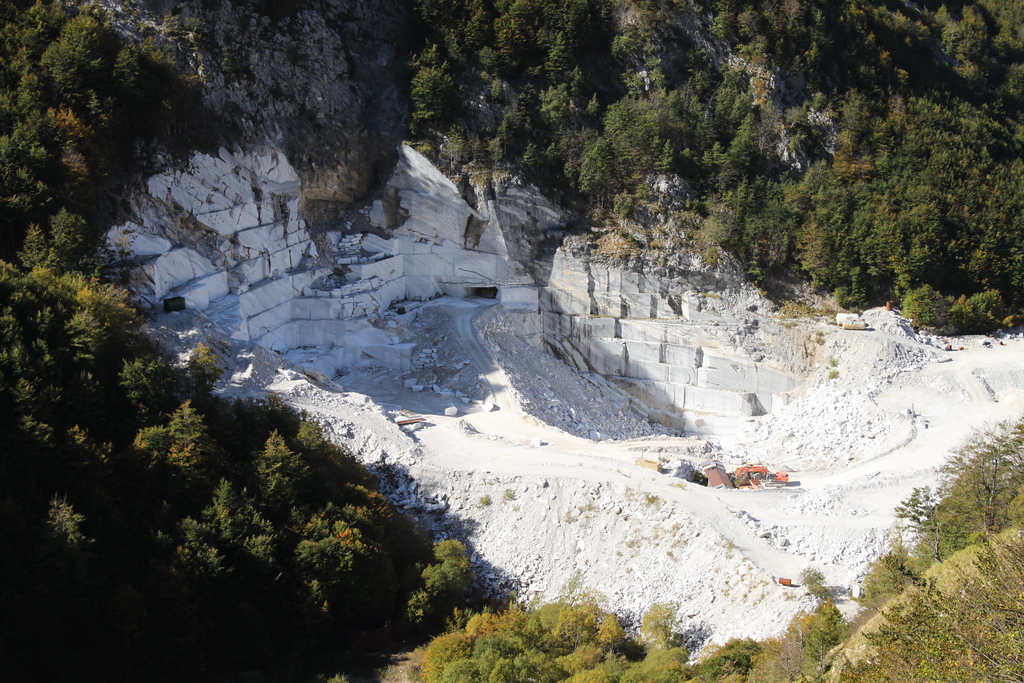
After a 7am rise on Saturday, we found ourselves driving up to Apuanes at an altitude of around 2000m. It is a beautiful area, replete with immense marble quarries, in the process of being serviced by similarly immense vehicles, all traversing the tiny mountain roads. The hike to the cave took around an hour and a half, and on arrival we feasted on hordes of focaccia and pizza of a quality that only Italians seem to be able to achieve. And then we were off! I had been warned that the cave was cold, and so I diligently wrapped up in thermals, furry and Warmbac oversuit. This was my first mistake, as clearly ‘cold’ is a relative term. I quickly found myself overheating, and was observed bemusedly by the local Italians, wearing their super-thin AV-suits with barely anything underneath. Not knowing how to explain in Italian that I had been “mislead” about the temperature, I could do nothing but grin and look like a novice.

Whilst I appeared to have no clue on what to wear in a cave, at least I was able to show off some of my Mendips-style caving prowess as we attacked the ‘tight’ entrance series (these guys clearly haven’t visited the end of the Virgin Series!):

“Around one hundred meters of frankly unpleasant tight passage… I regretted already that my kit was loaded with an incompressible sleeping bag and SRT kit. I turn around and observe with curiosity a certain Englishman who’s close behind. I see by his face he is perfectly happy. For him it’s spacious and easy, he’s not breaking a sweat and I see in his look he doesn’t understand why I’m not advancing more quickly!!”

Finally we arrived at Osanna, A fine and spacious 80m pitch carved out of the marble before us. I found myself struggling with the esoteric Italian re-belays, rigged to cover almost as much distance horizontally as vertically; it was impossible to pass them without using a good deal of upper body strength. I assumed they were just nuts, but I later came to understand that there was method in their madness…

Eventually we came to a series of pitches that could only be passed one by one, leaving a large gap in between each person. That seemed a little like overkill until I came to appreciate the frequent and unavoidable avalanches of rocks that fell at the slightest touch which were all around us. This cave isn’t like other caves I’ve been in. This cave feels like a 1000m extension of the “entropy increasing” scree slope in Xitu. The wide re-belays suddenly made sense. The last place you wanted to be on a pitch was underneath someone else, and I started to take comfort in even the widest and most testing re-belays.

After a slightly monotonous series 700m of pitches, we arrived at Chimera’s showpiece: “Touch in the Void”. This 160m monster of a pitch feels like an immense and impenetrable canyon; even the highest level on both of my lights failed to reveal walls opposite me, let alone below or above me.

““Touching the WHAT?? The void… The what? – The God-damned void!” Fred is in front of me and an “OH, F***”, escapes him!
Me: “What is it Fred, a rock?”.
Fred (in a small voice): “No, no, you’ll see…”

And there, I saw! Or, that is, I felt… the emptiness!
Oh my god!! It is a black hole. The most immense, horribly giant and enormous thing that the earth has created opens up in front of me and is about to swallow me up!”

This the first 1000m deep cave for my French comrade, and she was (understandably!) nervous. So was I. So once I found myself dangling from the roof on the 1cm thick rope, waiting for the next re-belay to free up, I couldn’t resist whipping out my trusty harmonica. This is an idea I unapologetically stole from OUCC’s David Rose. And what an idea! Despite my patent lack of any ability to actually play the harmonica, a stupid melody penetrating the immenseness successfully brought up the mood and we found ourselves cheerily descending the 20 Italian-style re-belays all the way to the bottom.

At this depth the cave changed character completely. We had entered a labyrinth of phreatic tubes occasionally frosted with “popcorn” type formations similar to that found in the Picos. It was here that I really started to first enjoy the caving. Winding passageways and small climbs are much more to my taste than endless pitches (I guess I have the Mendips to blame for that). But this section was all too short. It was not long before we found ourselves gazing into the turquoise waters of the final sump. A pleasing river leads up to a sandy “beach” by the edge of the water, and the passage dives straight down into the foreboding clear waters. This has been dived to a depth of 10 or so meters, and all I know of the outcome is that “It keeps going down”.

Well, now we’ve reached the bottom, I suppose I should come clean. I had decided to bring my camera with me on this trip. That is: my SLR, four high power flashes, twenty AA batteries and four sets of triggers, all in a 1.5kg Peli 1300 case. Oh, and a tripod. Yes, perhaps I overestimated my fitness when I imagined that I could carry all that, 2L of water, food, and a sleeping bag down to -1000m and back, whilst keeping up with my (somewhat less burdened) comrades. More of that later… For now, I took the opportunity to take a set of photos for the occasion, already not looking forward to the daunting climb back out.

Of course, on arriving back at the bottom of “Touch in the Void”, I couldn’t resist trying to take a photo before I ascended. Perhaps unsurprisingly, I ended up with a set of extremely underwhelming photos that I’d be embarrassed to show you. But I know you’ll still want to get some idea, so here’s an artist’s impression of what the pitch looks like from the bottom:

Due to the faff (incidentally a word that is not part of the French lexicon. I’ve started introducing it: “la faff” is already catching on in my office…) of playing with various flashes and tripods, I found myself alone at the bottom of the pitch with Marc, as we waited to ascend. I was standing probably 30m from the bottom of the rope to stay out of the way of anything that might be knocked down, and that might seem like a lot. But suddenly there was a series of crashes from above, and I instinctively new to leap up against the wall. It was flat and unforgiving, but I pressed myself against it in a star-shape. The crashes got bigger, and more frequent, and it then it literally rained rocks. Not small pebbles, but large multiple-kilogram masses that hurtled down the shaft and splintered in front of me. I remember bracing myself for the possibility that one of the several slabs of car-like proportions, that I knew to be above me, might come unhinged and plummet to the floor around me. But fortunately it died down, and all that remained was a strong smell of gunpowder and a smattering of broken stone at my feet. Ten frantic seconds were spent as we shouted to communicate with those at the various stages of the pitch and to ensure that everyone was ok.

“The line of light above and below me is making steady progress… Not a sound… but then a SCREAM! The first Italian at the top of the pitch has shouted something!
I see a BOULDER, pass in slow motion in front of my eyes… I close them… and I await the immense crash below.
Below, yes, below with the rest of my team…
I didn’t want to believe it, it was a few fractions of seconds that elapsed before hearing a voice “tutti va bene?” “bene?” “Si! Si!” “Oui! Oui!”
Everyone is alive.
I don’t remember saying any words other than: “Fred! I was scared…”
And I didn’t receive any response from him other than “Oui…””

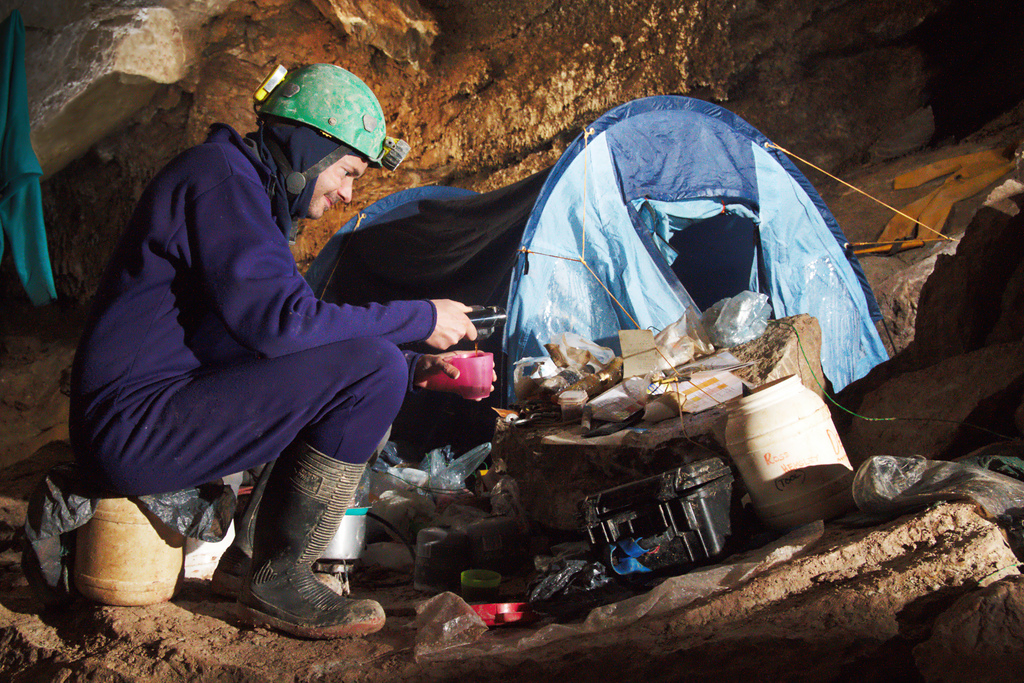
I slightly timidly started ascending the rope, and after a further 30 minutes spent dangling around 150m off the ground at the top of the pitch waiting for the rope (which seemed to have got stuck or something? I don’t speak Italian!), I was at the top. By this point I was quite tired, and I dragged myself back to the gallery at -700m that has become camp. It’s a lovely camp, and for the first time I got to appreciate the pleasingly warm glow of carbide, as the Italians had set up some kind of huge carbide lamp in one corner that illuminated the whole chamber. But we didn’t stay up long, some hot noodles were had and we finally hit the hay at 1am (hay is probably the wrong word to use for the slab of cold rock which was the reality!).

We slept in until 9:45 the next day, and after a classic underground breakfast of whatever we could lay our hands on, we set off. It was here that I started to be worried about keeping up. With all of my photography gear filling an enormous and unwieldy tackle sack, which of course got stuck at every opportunity, I was starting to struggle to keep up pace. I didn’t want to seem unfit, and I had ended up caving next to an Italian who didn’t speak any French, let alone English, so I couldn’t really explain. Finally he saw me struggling and relieved me of a few kilograms. The going became much easier but I still felt like I was letting team-UK down by appearing to struggle with only one tackle sack! Finally though, we got to my favorite and squeezy entrance series, and we popped out to a spectacular sunset. I was more than a bit glad to be out, and after another feast on Italian focaccia, we set of on the five-hour drive back to Nice, ready for work the next day. Not too bad for a weekend’s caving!

A lazy Saturday night’s composition

I haven’t been playing much guitar recently, and certainly not doing much writing. But now and then I have a lazy evening and feel motivated to put some riffs together. Here’s the slightly Pink Floyd’esque product of this evening. (Along with a drum track I wrote for a completely different song, which seemed to fit surprisingly well…).

Audio clip: Adobe Flash Player (version 9 or above) is required to play this audio clip. Download the latest version here. You also need to have JavaScript enabled in your browser.

Android id3 Woes and Solution

I have been having some trouble with my Android phone (2.2 Froyo, Desire HD), in that it seems to fail to read the id3 tags of most of my music.

On my computer, all the artist names are successfully recovered, however as soon as the files are transferred to the device, the media manager which indexes all the audio files fails to pick up the ‘artist’ tag. This means that most of the files are listed as “unknown artist”, rendering the device all but useless as an mp3 player (unless you are significantly more patient than I).

This problem seems to have been experienced by many, many people, for some time. Shame on you Google for not fixing it…

Anyway, I managed to get my tags working after around 6 hours of work. The trick is to change the id3 tags to something that the Android device will read. I don’t claim to know exactly what the problem is, but I do know that doing the following fixed the problem for me. The following assumes you are also using Ubuntu. I’m sure that trying similar things would work on Windows/Mac.

My Fix

1 ) Remove all your music from your Android phone. Maybe this is not necessary, but it’s probably a good place to start.

2 ) Download and install EasyTag. This will allow you to modify the id3 tags in your music collection.

3 ) [In EasyTag] Go to preferences, and set them as follows. You may find that you do not require your settings to be set like this, but setting them like this works for me.

4 ) Select the music files that you wish to put on your device by navigating to them in the browser. You can now use the ‘Scanner’ to make the naming conventions consistent. I’ve done this to my music, however be careful with this tool as you may end up with tracks that have blank names! (I think I managed this by running it on some files with no tags).

5 ) Select all the files that you want to adjust, and hit ‘save’. This will write all the new id3 tags to your music.

6 ) On your phone, go to Settings -> Applications -> Manage Applications -> All -> Media Storage. Now hit ‘Clear Data’. This should clear all the cached library information on your phone. (I have a hunch that if you re-write id3 tags without changing the file name, the phone probably won’t refresh the library).

7 ) Copy all your music to your phone using your favourite method. Probably best to try this using a file manager just to ensure that your media player is not doing anything magic.

8 ) Open a music playing application, hopefully you should no longer have any broken song titles.

9 ) Complain to Google for taking so long to sort out this important feature.

Let me know if this helps anyone :)

Barista in the Mountains

Espresso at -600m
Jamie Jordan pouring an espresso at underground camp (-600m) in Pozu del Xitu, Asturias, Spain.

A few weeks ago, I posted to say that I had been sent a travel espresso machine by Handpresso and that I had the intention of taking it on expedition. Well I have now returned and despite several bouts of torrential rain, a path to base camp that was muddy enough to absorb an entire man and a herd of voracious cows that ate their way through an array of hiking clothes, I am pleased to report that the coffee available was second to none.

Before setting off, I ordered in 70 ESE pods in a variety of flavours for the trip. Of course, most of these were drunk in the mornings over a bowl of Mornflakes, however my real intention was to take the machine underground. Immediately though, I encountered my first problem: I had forgotten to bring an espresso cup with me. This tragedy was soon averted by “temporarily borrowing” an espresso cup from the Maria Rosa cafe. Unfortunately I did not know enough Spanish to ask them directly, so this was carried out by simply slipping a cup into my pocket after a meal.

The next problem was getting the machine underground. This was done when Nick, Harvey and I left for a pushing trip to Chunder Pot, which is around -1,000m in Pozu del Xitu. This impressive Picos cave has a lot of history, and its original exploration is documented in the simultaneously fascinating and terrifying book Beneath the Mountains (link gives free access to this as an e-book). To reach our destination, we had to stay at camp at around -600m. This seemed like the perfect location to sample the joys of underground espresso. In a place where the morning is not announced by the coming of the sun, there is nothing like an espresso (or three) to get things started in the morning.

Since I wanted to capture this momentous occasion on camera, I had to take my photography gear down. This took up an entire large tackle back when including a pair of dry socks and a hat for underground camp. Thus I stashed the machine in a Darren drum in Harvey’s bag. When he learnt that he had carried the coffee apparatus down 600m of tight and awkward cave, he seemed a little unimpressed. Perhaps more so because he doesn’t even like coffee.

When the final moment arrived, it was clear that this was not some insane errand. Whilst espresso tastes great on any normal occasion, espresso prepared hundreds of meters underground, days from any possible rescue and miles from the nearest civilisation tasted fantastic. Whilst I had intended to return the machine to the surface on my return, I decided to leave it at camp so that the other pushing parties could share in the experience.

More espresso making
Harvey Smith at underground camp (-600m) in Pozu del Xitu, Asturias, Spain.

Ultimately, all 70 pods were drunk in the three week period I was in the Picos, mostly by Jamie and myself. The machine attracted a lot of attention, and I dare say it has found its way on to the wish lists of many.

So after an expedition hampered by bad weather and insatiable cows, we can rest assured that we consistently drank better coffee than you’re likely to get in any UK coffee establishment, cheers Handpresso!

Oh, and to those who took exception to my theft of the espresso cup, I can assure you that I did in fact return the cup at the end of the expedition. Of course, they probably have no idea why a particularly bad smelling and muddy Brit appeared out of the clag to hand them back one of their espresso cups, and I certainly couldn’t explain using either of the two words of Spanish that I know. Perhaps someone will be able to explain next year and I can give them a print of one of the photos!

Recent Meddling on the Ukulele

On the Christmas before last, I received a fairly cheap Uke as an, in retrospect, rather inspired present. That Uke then went to the Picos, Albania, France, Switzerland, Bristol, London, Cambridge and many more. I have since bought myself a rather nice electric Uke and have decided to try and commit some of my compositions/arrangements to disk. Here is one of the first things that I wrote for Uke which I just keep coming back to (feel free to steal it if you like it!) :)

Audio clip: Adobe Flash Player (version 9 or above) is required to play this audio clip. Download the latest version here. You also need to have JavaScript enabled in your browser.

And here’s another track I’ve been working on:
In fact, I can’t resist adding some bass and drums to that:

Audio clip: Adobe Flash Player (version 9 or above) is required to play this audio clip. Download the latest version here. You also need to have JavaScript enabled in your browser.

Cave Photography on a Shoestring (new gear, things I’ve learnt)

I’ve recently been investing into more cave photography gear, and so I thought it would be worth sharing the things that I have learnt recently.

Stu in Eastwater

Camera Protection: Probably my most useful purchase so far has been my Peli Case (1300). A good tip is to spend a long time on e-bay hunting for one going cheaply (mine was £30, much less than retail). The size is another problem. I decided to go for a 1300 since it gives me the extra space to store all my flashes (though you need a larger tackle bag for it). This really is a worthwhile purchase, since being quick when taking photos is important: you do not want to anger your subjects/slaves.

Triggers: Another great purchase has been my set of Cactus V4 wireless triggers. I bought them for a tenner on e-bay, though you’ll probably end up spending around £30 unless you hunt for months like I did! They are super reliable and work over long distances. They also remove untold amounts of faff when dealing with pre-flashes etc. My set-up now includes two Cactus V4 receivers and two Firefly 2′s. My advice to those considering buying triggers would be: If you have a hot shoe on your camera don’t buy the Firefly 3 instead, invest in some Cactus V4s. It’ll be cheaper in the long run. That said, Firefly 2s are a very good and reliable way to fire extra flashes.

Lighting: I haven’t got involved in the slight craze over flash bulbs, for three main reasons:

  1. I’m a poor student, and can’t afford to spend hundreds of pounds on single use bulbs.
  2. Flashguns are cheap, reliable and you can fire shots off all day.
  3. Flashguns can make photography faster and easier.

That’s not to say that I wouldn’t love to play with some of them if I could afford it! In any case, I have come across a few good flashes which seem to be ideal for taking underground. Probably my favourite is the Vivitar 283, instead of the highly coveted Vivitar 285. Unfortunately, due to its popularity, the 285 seems to be quite hard to get without spending over £40, which I would consider too much for something that’ll probably end up at the bottom of a pothole one day. In contrast, you can pick up the 283 for £15  on e-bay (the astute reader will be noticing a theme in my purchasing habits), and they are wonderfully built and extremely bright. If you then do some cunning fiddling with potentiometers, you can make them fully manual (something I hope to do before Expo this year).

So, along with two Vivitar 283s, I have bought two Sunpak flashes (MX 134, and a 2400). Both of these are highly powerful and versatile. (In particular, the 2400 has a fully manual power dial). Total cost for all four flashes was around £35. Although two of these came in ‘job lots’ on e-bay, so I now have a surplus of about 15 other various flashes which I hope to sell for a few pounds each: I may I even make a profit.

Photography: I have also learnt a lot about taking pictures. My first most important lesson has been that you can make a photography moment amazingly fast. If you have four flashes and a camera ready to go in a Peli case, then with some quick placements, a snapshot can be done in under 15 minutes, which is great for those ‘unstaged’ photos of actually moving through a cave.

On a more technical note, I have been playing with flash placements, and found that it takes a surprising amount of skill to place flashguns in the ‘right place’. I would offer advice, but I am still working on this myself. Hopefully I will be able to impart more wisdom in a future post :)

Photos: For those wanting to see my other attempts, feel free to peruse my Flickr.


Quality espresso at -1,000m: Handpresso

I’m currently planning to head out for the last two weeks of the OUCC Picos expedition, followed by the last two weeks of the CUCC/UBSS Austria Expedition. Both of these are well established caving expeditions, with plenty of new and unexplored passage yet to be discovered. The problem is, when spending a long time at base camp, there is no way to get good coffee. This is even more true at underground camp! Well, in looking for a solution to this problem, I came across the Handpresso. This is a remarkable little machine that can be taken anywhere, making perfect espresso every time. This seemed too good to miss, and after a short exchange of e-mails, the guys at Handpresso kindly agreed to send one to use on expedition this year. Since the unit arrived today, I thought I would put up some pictures of the unboxing.

My first impression was this is clearly a well made piece of kit. It comes in a stylish case and is well presented. It feels well made and sits nicely in the hand.

This particular model is designed to take E.S.E pods, which are  a standard way to pack doses of espresso. Whilst I normally like to grind my own beans, I think that this is a sensible design decision for something that I hope to take thousands of meters below ground.

So now for the important part: how is the coffee? – Well I was very impressed, It takes a good 18-20 seconds to run through a shot (and any less would result in a poor quality espresso). The crema is full and glossy, and the taste is impressively good (even compared to my home-ground coffee and Gaggia classic).

Hopefully I will be able to get some shots in the wild soon (pun intended)! - I plan to take it to mountain biking, and perhaps to Font for some bouldering. Of course, the ultimate aim is to take it down to below 1,000m. If I can do this, then it will almost certainly be the deepest (good quality) espresso ever poured!

- Watch this space for updates in the coming weeks -